Outlook | Mar 2026 | 7 min read
Small Events, Big Impact – Why Micro Events Are Winning Community Engagement
A $30,000 festival that drew almost no crowd, and the block-party pivot that followed.

How NoMA BID prevented $33,138 in missed assessment revenue
For years, assessments at NoMA BID were reconciled the way most districts still do it, in a stack of spreadsheets, once a quarter, by hand. When the finance team finally walked the old parcel inside a proper system...
Cases from DC's 311 system now flow into the platform automatically. What used to take 15 minutes takes 5.
Clean, Safety, Outreach, and Ambassadors each ran on their own tool. Fixing that tripled shift output.
Thousands of open requests compressed into a daily workflow the team can actually see, triage, and close.
IDA's 2026 Top Issues Councils, and what they mean for downtown teams on the ground.
Downtowns still carry around 11% of a city's taxable value on roughly 2.2% of its land. With weekday worker presence sitting below overall visitation, districts are rethinking how they underwrite that concentration, support building owners, and answer the office question at the board table.
More districts are building, pricing, and renewing membership as a second leg of revenue, not a marketing program. The operational question is how to run it at scale, align tiers to real value, and keep renewal rates intact without adding headcount.
The FIFA World Cup and America's 250th Anniversary both land in 2026. Host downtowns are asking how to turn that once-in-a-decade visitation into lasting stakeholder narrative, measurable business impact, and a cleaner story for the next renewal cycle.
Monday through Thursday retail traffic is still running 16 to 17 percent below 2019. Persistent vacancy is now the baseline, not the exception. Districts are leaning on activation, adaptive reuse, and corridor strategy rather than waiting for foot traffic to return on its own.
Our long-form take on the shifts behind the headlines. Written for the people running districts, not the ones writing about them.
Outlook | Mar 2026 | 7 min read
A $30,000 festival that drew almost no crowd, and the block-party pivot that followed.
Outlook | Mar 2026 | 7 min read
AI has moved from quiet experimentation to the center of district marketing.
Outlook | Mar 2026 | 7 min read
A look at how districts are measuring event ROI, understanding economic impact, and building a clearer

Outlook | Mar 2026 | 7 min read
Traditional foot traffic and spending metrics only tell part of the story.
A quick look at what each team did to move the number that mattered. For the full story behind each, follow the link.






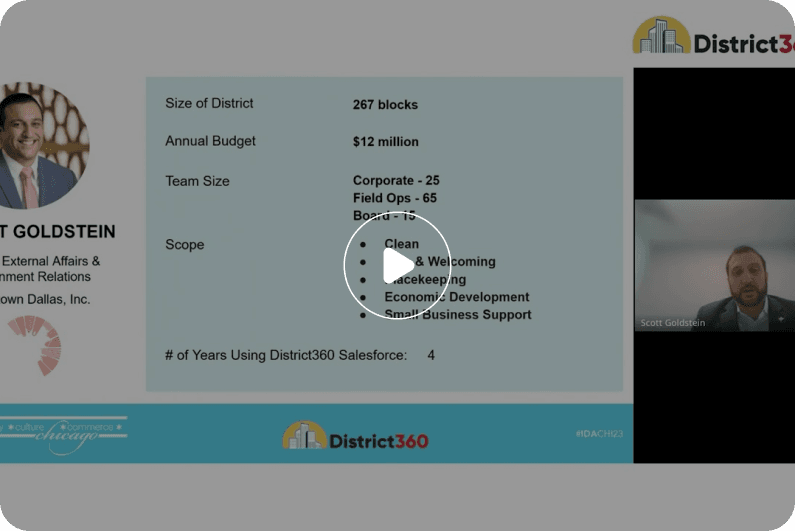
Roundtables, IDA sessions, and interviews with district leaders on what's actually working, what isn't, and what they're trying next.
District360 is a district management platform built specifically for downtown organizations. BIDs, BIAs, DDAs, Main Street organizations, community benefit districts, and place management teams use it to replace disconnected tools and run their CRM, public space operations, board reporting, stakeholder engagement, assessments, and membership programs from one system.
75+ downtown organizations across 30+ cities in the United States, Canada, and the United Kingdom run on District360 today. The platform manages over 500,000 property, business, contact, and asset records, and has maintained a consistent 5-star rating on the Salesforce AppExchange since launch.
Most districts go live on a core District360 configuration within 8 to 12 weeks, with module rollouts staggered after that. Timelines vary with district size, the modules being deployed, and how much legacy data needs to be migrated. Our implementation team plans around the district's calendar, not the other way around.
Districts typically adopt District360 to consolidate scattered spreadsheets and tools, improve board reporting, run public space operations in real time, manage stakeholder and board relationships, track assessments and properties accurately, grow membership revenue, and build the data record that defends renewals. Every module exists because a real district needed it.
Yes. This Insights page is where we publish our perspective on the industry, share customer outcomes, host roundtables, and recap IDA sessions. We publish a monthly newsletter, and we contribute to the broader conversation in the downtown and place management community through the year.
You can subscribe to the monthly newsletter above, or reach the team at [email protected]. If you would like to see the platform in action, you can schedule a demo from the top navigation. Every demo starts with a conversation about your district, not a generic walkthrough.
Every demo starts with your district. How you work today, where the friction is, and whether District360 is the right fit. No generic walkthrough, no pressure.