logo
Outlook

Hidden Costs of Not Using a District-Specific CRM

Most people who work in districts support businesses, track properties, organize events, manage stakeholders, all while trying to get back to that email from three days ago. But even the best teams can be held back by the wrong tools. Some of these costs are obvious. Others are the kind that only show up when you stop and add them up.

Managing downtown district data and tools
Why this matters

The cost of the wrong tool is not just the subscription. It is everything the tool forces your team to do around it.

Generic platforms were not designed for the way downtown districts work. That gap between what the tool does and what your district needs is where time goes, data gets messy, and teams quietly burn out on workarounds.

Overview

There are two ways this tends to go. Neither is free.

Some districts invested in a platform but chose one that was not built for the way districts actually operate. Others are still making do with spreadsheets and a collection of disconnected tools. Both situations carry real costs, and most of those costs are invisible until they compound.

The costs are not always financial in the obvious sense. They show up as hours spent on workarounds, data that cannot be trusted, departments that cannot coordinate, and stakeholder relationships that slip because nobody had a clear record of what had already been said. They show up as good people leaving because the tools make every task harder than it needs to be.

If you recognize something here, you are not alone. Most districts are somewhere on this spectrum, and the first step is being clear-eyed about where the friction is actually coming from.

When your platform is not built for districts

You have invested in a platform. It still might be costing you.

Choosing to use a platform is a sound move. But a generic yet capable one creates a different kind of problem. It was built for companies that sell products, manage customer pipelines, or run marketing campaigns. It was not built for a district that tracks storefronts, manages board relationships, coordinates ambassadors, and runs clean-and-safe programs simultaneously.

Cost 01

You are stuck customizing endlessly.

Making a generic platform work for your district often means bringing in outside consultants, and consultants who do not understand how a district operates have to learn your world before they can help you. That learning curve is not free. You pay for the time it takes them to understand what you do, and then you pay again for the work itself.. It is not just the money. Explaining how a district functions, what a BID levy is, why stakeholder relationships work differently from typical customer accounts, all of that takes your time too. That time belongs to the actual work of running your district.

Cost 02

It cannot track what you need it to.

Most platforms simply were not built with business turnover rates, vacant storefront tracking, board member management, or clean-and-safe service requests in mind. You end up either building messy workarounds to approximate those things, or giving up on tracking them at all. Either way, important data is falling through the cracks and the picture you are presenting to your board is incomplete because the tool cannot hold the full story.

Cost 03

You get the wrong kind of data.

When the platform does not match how your district thinks about its work, data quality deteriorates in predictable ways: misspelled names, missing property details, and duplicated records because the fields are never quite right for what you need to capture.

  • Contacts logged twice under slightly different names, with neither record complete.
  • Tenant records that do not reflect recent turnover because there was no clear field for it.
  • Reports that show three different formats for the same street name, making comparisons meaningless.
  • Fuzzy data leads to missed opportunities and wasted outreach, and the longer it accumulates, the harder it becomes to clean up.
Cost 04

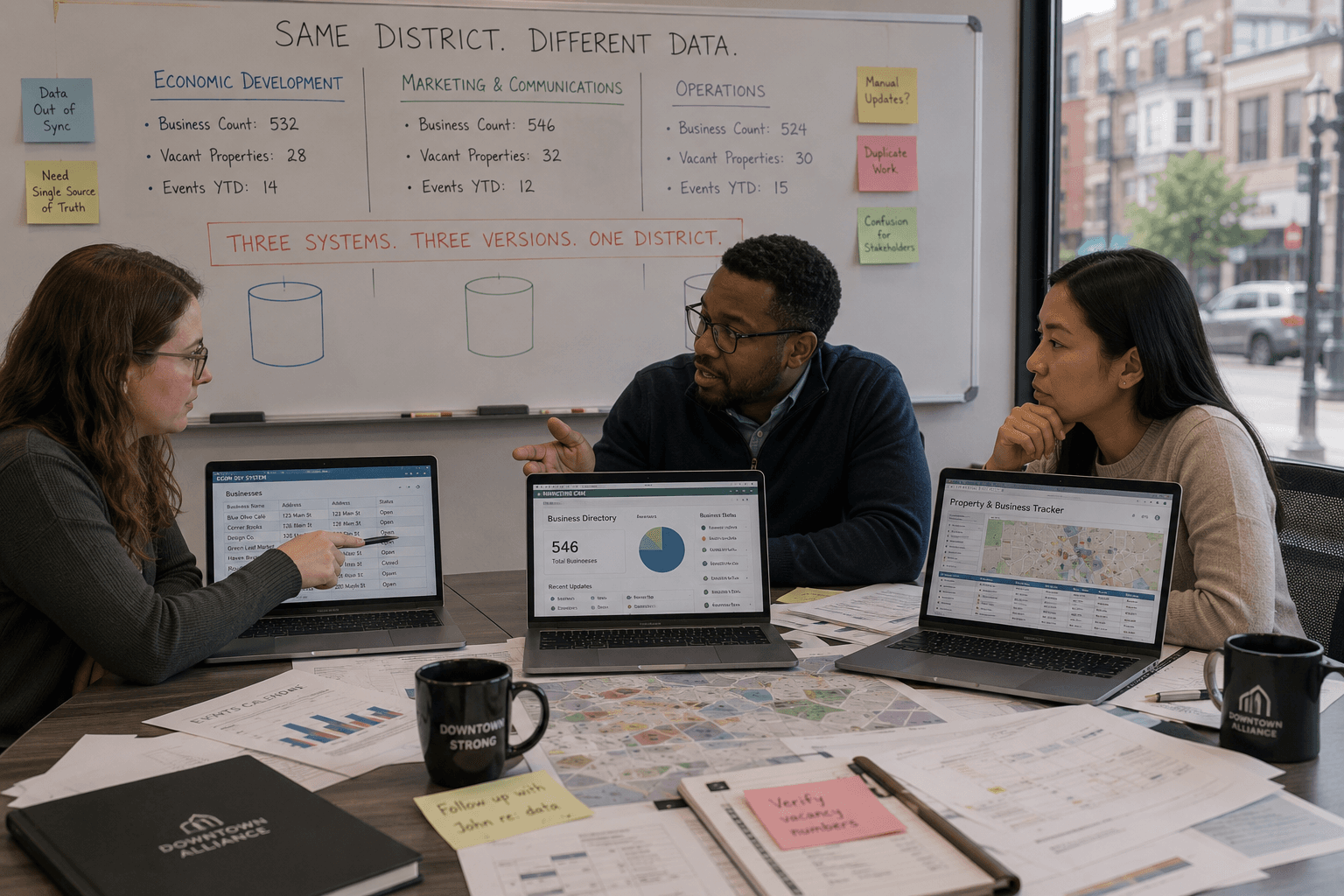
Departments get out of sync.

If your operations team is logging graffiti reports in one system and your outreach team is recording business visits in another, nobody is working from the same picture of what is happening in the district. Coordination becomes harder. Communication becomes slower. It is the operational equivalent of two teams working in different offices who are supposed to be serving the same block. The information exists; it is just separated in a way that makes it nearly useless for anyone trying to see the whole picture.

Departments working from different systems

Built for the way your district actually works.

District360 was built by people who came from your world. Every object, every field, every default dashboard was shaped around how downtown teams actually operate, so you spend less time configuring and more time using.

When you are not using a platform at all

Spreadsheets and stitched-together tools carry their own price.

Maybe you are managing with a combination of spreadsheets, email contacts, and a handful of subscriptions that each do one piece of the job. It works, to a point. But here is what that arrangement is actually costing your district week by week.

Cost 01

Time leaking out of every day.

Staff spend hours looking for things, re-entering data between systems, and correcting errors that crept in because each platform keeps its own version of the truth. Operational inefficiency at this scale is not just frustrating. It is genuinely expensive. Reporting takes far longer than it should because the information is never in one place.

Cost 02

Data scattered across too many places.

Constant Contact for emails, Eventbrite for events, CoStar for properties, and Mailchimp for marketing campaigns. Each platform holds a piece of the picture, but nobody really knows which piece is current and someone is almost certainly working from a contact list that is well out of date.

Cost 03

Paying for the same capability more than once.

Five subscriptions doing the job that one could handle, each with its own login, its own renewal date, and its own learning curve for new staff. The overlap is rarely intentional, but it compounds quietly over budget cycles. It is like paying rent on three apartments and only living in one.

Cost 04

No sync means six versions of everything.

Update a contact in one platform and forget the others, and you will have multiple conflicting records for the same person. The version that gets used is usually whichever one someone opened first which is not always the right one. Data degrades faster than most teams realize.

Cost 05

Training that feels like a boot camp.

When a new team member joins, they have to learn six platforms, each with its own conventions and quirks. Onboarding time stretches, errors multiply in the learning period, and institutional knowledge lives in the heads of two or three people who have been around the longest.

Cost 06

No one knows the full history of a relationship.

Without a centralized activity log, you cannot always see who last spoke to a stakeholder, what was discussed, or what follow-up was promised. Relationships are harder to maintain when the history lives nowhere that means your team might reach out to the same business twice in a week, or miss a commitment entirely.

Scattered tools and spreadsheets in district management
WHERE THIS LEAVES US

The question is not whether these costs are real. It is whether you can see them.

Most of these costs do not show up on a balance sheet. They show up as exhausted team members, a board presentation that took twice as long to prepare as it should have, and a stakeholder who feels like your district has forgotten about them. The right platform does not eliminate the work. It gives the work somewhere to live.

How many hours did your team spend last quarter looking for information that should have been a single search?

Which of your current tools overlap in what they do, and what is the combined cost of that overlap each year?

If a key team member left tomorrow, how long would it take the next person to find everything they need to do the job?

Questions districts ask about making the switch.

Familiarity with a tool is real value, and switching always carries some disruption. The question worth asking is how much of your team’s time currently goes toward working around the tool’s limitations, and whether that cost is larger than the cost of a transition. A platform built for downtown districts reduces the ongoing tax of workarounds, which compounds quietly over months and years. Most teams find that the transition period is shorter than they expected, because the new system already speaks their language.

Existing data can be migrated during the setup process. The migration is handled with you, not handed off as a self-service task, and the goal is to arrive on the other side with records that are clean and properly structured. Your history has real value and should not be left behind. The contacts you have built, the property records you have maintained, the event attendee lists accumulated over years: all of it comes with you.

District360 was built with lean teams in mind. The platform is purpose-built for how downtown districts work, which means you do not need to configure it from scratch or hire someone to maintain it. The defaults are already set up around district operations. So a small team can get genuine value from day one without needing a technical specialist on staff.

Spreadsheets work until they stop working, and they usually stop working in ways that are hard to see in the moment: a contact list nobody trusts, a report that takes a full day to assemble, a relationship that slips because follow-up lives in someone’s personal email. The cost of "mostly works" is usually paid in overtime and stress rather than a line item on the budget. A centralized platform makes the hidden cost visible, which is the first step to reducing it.

Setup time depends on the size and complexity of your district and what data needs to be migrated, but most teams are operational within a matter of weeks rather than months. The onboarding process is structured around your specific context not a generic checklist. The goal is for your team to feel supported from the first week, not left to figure things out from a help center.

Continue reading.

Micro events and community engagement
Outlook · Events

Small Events, Big Impact: Micro-Events & Community Engagement

Placemaking conferences
Outlook · Events

Key Placemaking & Downtown Conferences to Attend

Downtown Halloween event
Outlook · Promotions

Downtown Districts Guide to Events & Promotions Ideas for Halloween

Working through this in your own district?

We are happy to share what is working for others.

District360 dashboard preview