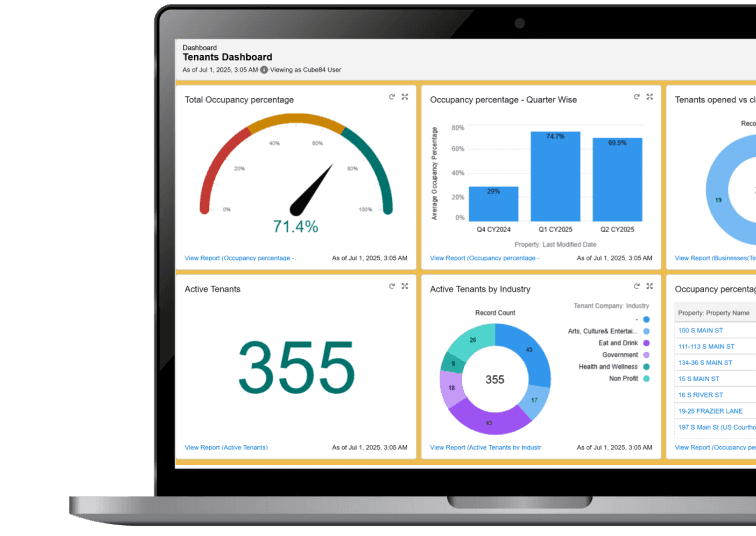
Run your district from one connected platform
One platform for the information, workflows, and reporting downtown organizations rely on every day. Properties, assessments, contacts, boards, businesses, communications, projects, and district reporting all connected in one place.
For BID staff, downtown districts, and place management organizations

Built specifically for downtown districts
District360 includes the core capabilities downtown organizations need to manage data, run programs, support boards, engage stakeholders, and report on district performance without relying on disconnected spreadsheets and tools.
Track assessments and catch revenue gaps
Assessment data by property with collection status, year-over-year comparisons, and ownership changes. Catch missed revenue, identify discrepancies, and report assessment performance to your board and city.
Manage vacancies and attract prospective tenants
Track every vacant space, current tenant, and prospective tenant in your district. Lease dates, vacancy duration, and a pipeline for business attraction. Know which leases are expiring before they become vacancies.
See every property and business with its full history
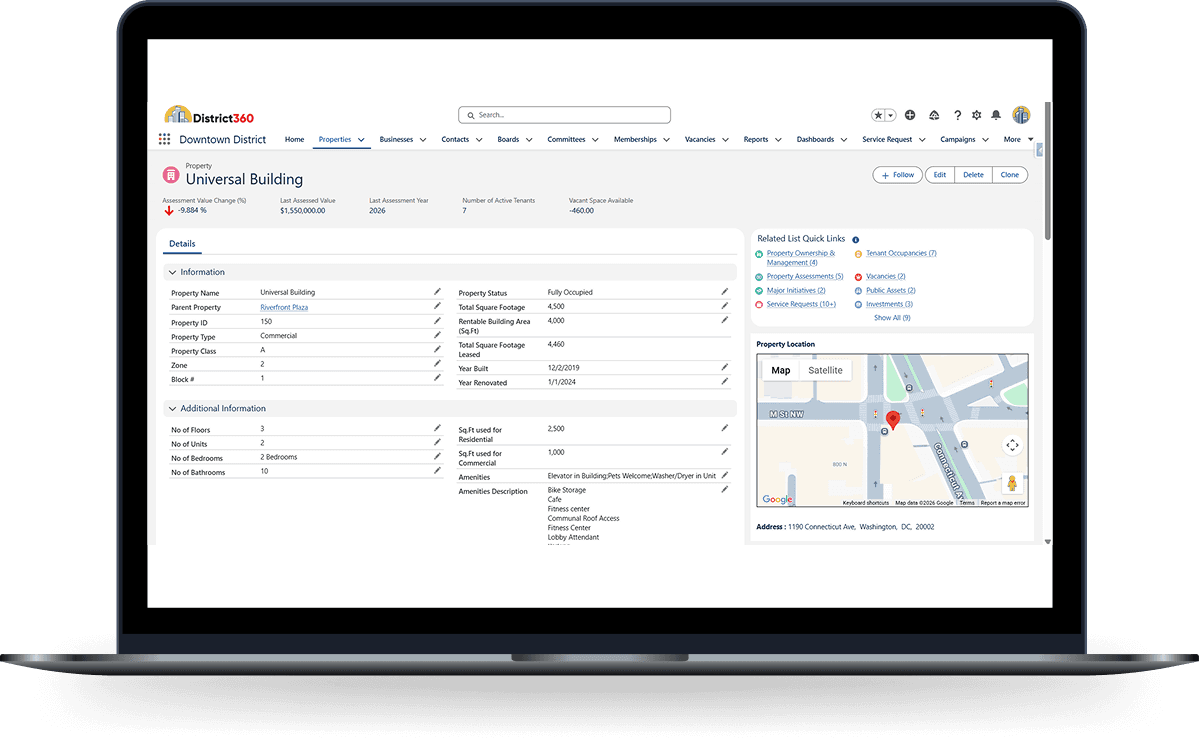
Look up any property and see ownership, tenants, assessment history, service requests, and board associations in seconds. Keep business data current with live Google integrations. Manage your business directory from the CRM.

Public assets and service requests
Catalog every public asset in your district: benches, lights, planters, signage, trash receptacles. Track location, condition, and maintenance history. Log service requests, assign cases, and track resolution. Your district service center for tracking what happens on the ground.

Marketing communications and engagement
Send targeted updates to property owners, board members, sponsors, or any stakeholder segment. Track engagement. Integrates with Mailchimp and Constant Contact. Communication history logged against every contact. District-wide communication from one connected system.
Projects, grants, and major initiatives
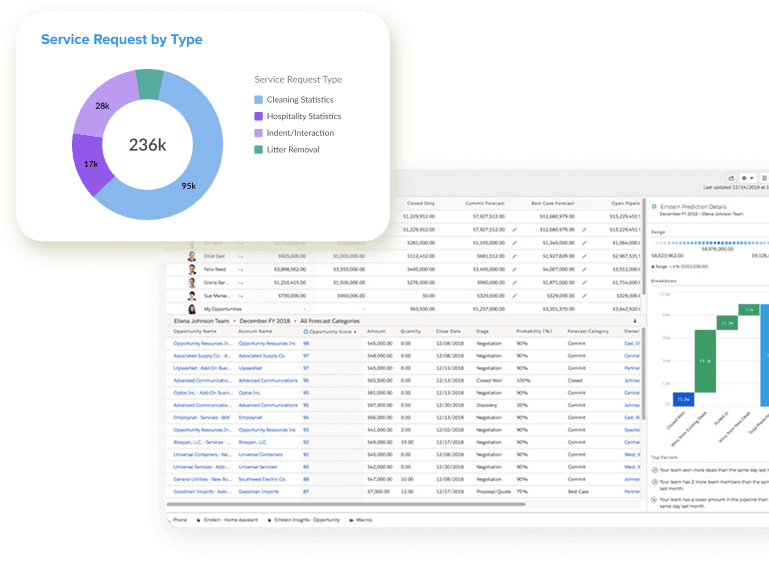
Multi-year, multi-stakeholder projects tracked from concept to completion. Economic development programs, capital projects, grant-funded initiatives, and community placemaking. Projected vs actual amounts, sponsors, partners, and related properties.
Board governance
Boards, board members with term dates, committee structures, meeting schedules, attendance tracking including proxy, and quorum checks. Board members linked to their properties and assessments. Everything your governance needs in one place.

Dashboards and district reporting
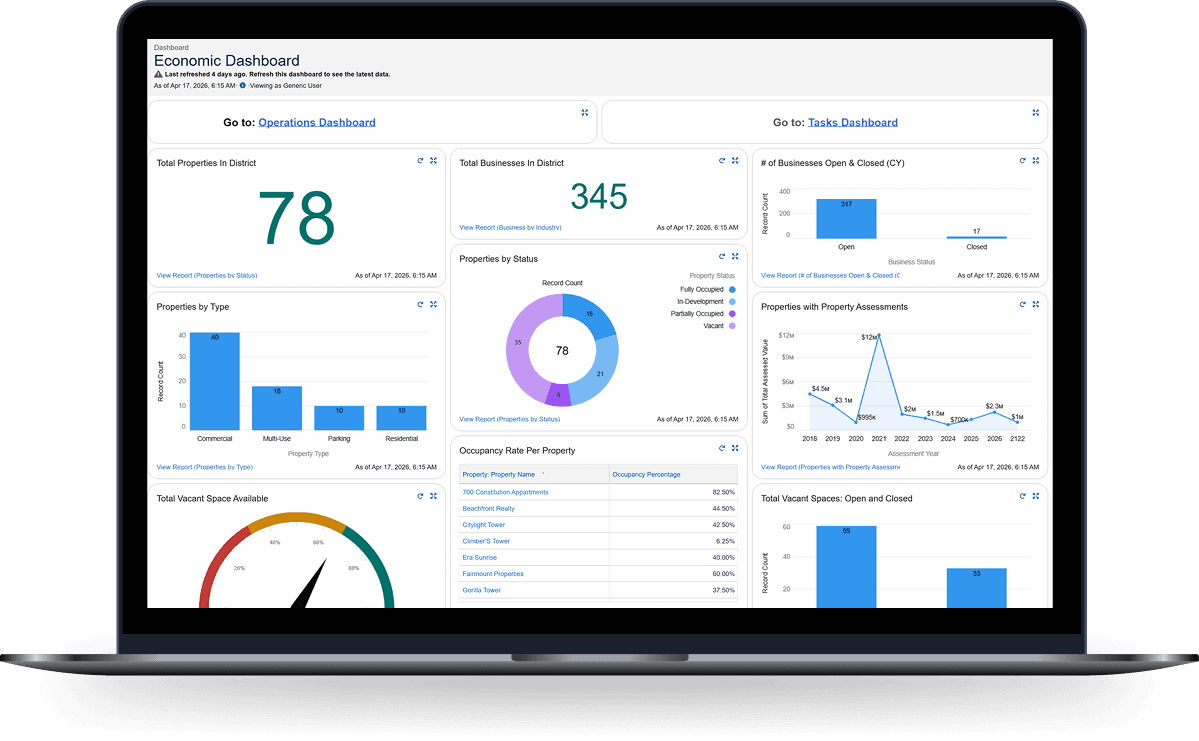
Board-ready dashboards that update automatically. Assessment collections, occupancy rates, vacancy trends, service activity, stakeholder engagement, and district metrics across every program. Build board packets, city reports, and a district report card in minutes.

Not just a generic CRM
Most CRMs were not designed for the way downtown organizations work. They do not naturally understand properties, assessments, board governance, business directories, vacancies, or district reporting. District360 was built around these workflows from the start, so your team spends less time adapting the tool and more time using it.
Built for district data and workflows
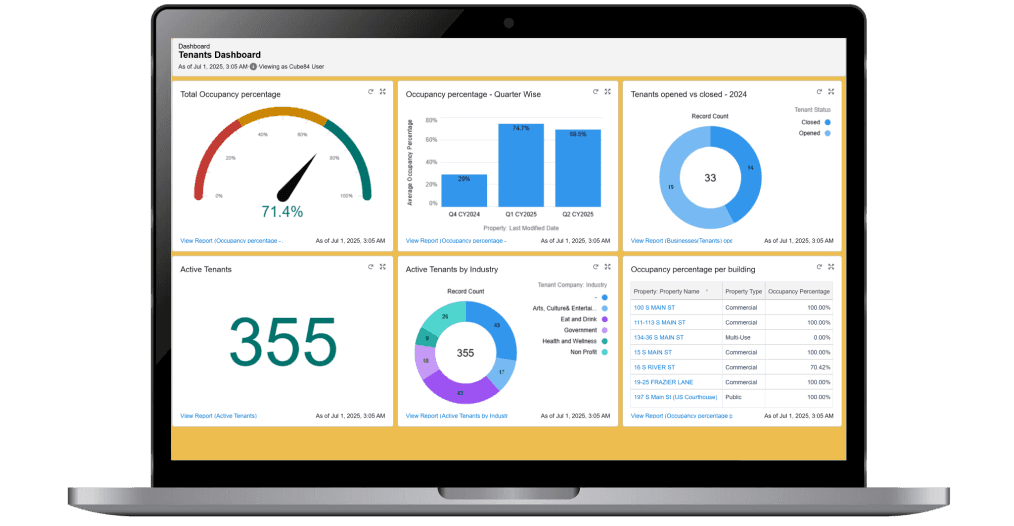
Reports and dashboards ready for your reporting needs
Works with the tools districts typically use
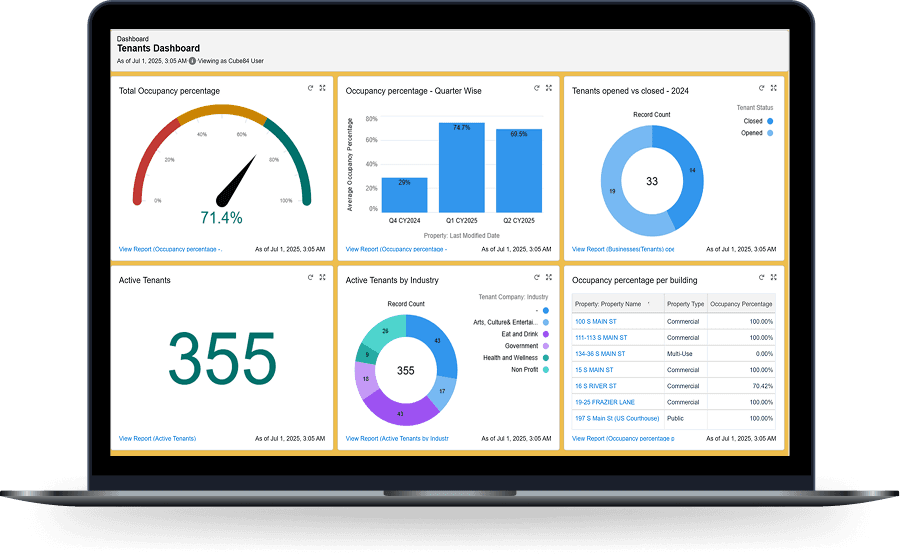
What you can report on
District360 helps you report on the numbers your board, city, and stakeholders actually care about. Every report updates automatically with live data.

Assessment collections

Vacancy trends

Property ownership changes

Ambassador activity

Service requests

Stakeholder engagement

Business openings and closures

District metrics and KPIs

Everything connects. That is the point.
A property connects to its owner, its tenant, its assessment, its businesses, its board member, and its service history. A contact connects to their properties, their board seats, their communication history, and their volunteer activity. Nothing exists in isolation.
Properties, businesses, and assessments
People and organizations
Programs and operations
Governance

The District360 architecture really works for the way a downtown district operates. Setting up properties as the primary unit makes intuitive sense for how we think about our data. The managed support is excellent too. The team is responsive, keeps track of progress, and always has the resources to tackle new projects.
From discovery to go-live
Most districts are live within 2 to 4 weeks. We handle data import, platform setup, and training. Your team focuses on learning the system and getting comfortable with the workflows.

Discovery
We start by understanding your district's terminology, workflows, reporting expectations, and how your team operates day to day.
You share your data
Most districts share spreadsheets and exported files for properties, contacts, assessments, board rosters, businesses, and other key information.
We import your data
We clean, structure, and import your data into District360. We guide you through gathering anything that is missing or incomplete.
We configure and implement
We set up District360 around your needs, workflows, terminology, and reporting requirements. If needed, we also connect it with other systems your district already uses.
We train your team and go live
We provide role-based training and support your team through go-live with a dedicated project manager. Ongoing support continues after launch.
Works with the tools districts typically already use
District360 can connect with the other tools your organization already relies on, reducing duplicate work and improving visibility across teams.







One platform. Different views for different roles.
Executive Directors
Board reporting, stakeholder relationships, assessment oversight, district-wide dashboards, and major initiatives.
Operations and Public Space
Ambassador patrol tracking, service requests, public assets, quality of life reporting, and case resolution.
Economic Development
Property data, vacancy tracking, tenant pipeline, assessment management, occupancy trends, and business tracking.
Marketing and Communications
Contact segmentation, targeted outreach, email integration, engagement tracking, and sponsorship management.
What districts achieve with the CRM Platform
to prepare board reports that used to take three to four days of manual assembly


in missed assessment revenue recovered through better property and ownership data

increase in downtown occupancy tracked and reported to the board and city

spreadsheets needed for properties, contacts, assessments, and board governance

replaced 5+ disconnected tools connecting all departments and programs
Frequently asked questions
A downtown CRM is a platform designed specifically for downtown districts, BIDs, and place management organizations. Unlike generic CRMs, a downtown CRM includes purpose-built structures for properties, assessments, board governance, vacancy tracking, business directories, and district reporting. District360 is the downtown CRM that district teams have been asking for.
Most districts are live within 2 to 4 weeks. Implementation includes discovery, data cleaning and import, platform setup based on your terminology and workflows, role-based training, and go-live support. You are assigned a dedicated project manager who guides your team through every step.
Yes. We handle data migration for property records, assessment data, contact lists, board rosters, tenant information, business directories, and any other structured data your district currently tracks. We clean and structure the data so it works properly from day one.
Yes. That is exactly what District360 was built for. Properties, assessments, contacts, businesses, vacancies, tenants, board governance, and service requests all live in the same platform. Every record connects to every other record.
District360 includes customizable dashboards and reports for assessment collections, occupancy trends, vacancy data, business activity, stakeholder engagement, service requests, and district metrics. You can build a district report card, board packets, city reports, and KPI dashboards. Reports update automatically with live data.
Yes. You can build a district report card that tracks any combination of metrics: occupancy, assessment collections, service delivery, business activity, stakeholder engagement, and program outcomes. It updates automatically so you always have a current snapshot ready for your board or city.
District360 serves BIDs, BIAs, downtown development authorities, special improvement districts, community benefit districts, Main Street programs, downtown partnerships, and other place management organizations. Customers range from 5-person Main Street programs to 200-person downtown partnerships.
The CRM Platform is available through two subscription tiers. The Growth plan is $4,800 per year. The Starter plan is $1,800 per year for smaller organizations. Implementation is a one-time cost. Managed services, training, and ongoing support are available at $100 to $175 per hour. Schedule a demo to discuss which plan fits your district.
No. District360 is designed for lean downtown teams. Most customers do not have dedicated IT staff. We handle platform setup and customization during onboarding. Managed services, help desk, and regular check-ins continue after launch for ongoing support.
Yes. Many customers start with properties, contacts, assessments, and reporting, then add vacancy tracking, board governance, business directories, communications, or D360 Streets over time. The platform grows with your organization.
See how the CRM Platform would work for your district
We will walk through your properties, stakeholders, reporting, assessments, and operations using your district's data structure. No generic demo.